See Beyond 20/20

We know you wouldn’t trade your priceless vision for anything. That’s why your annual comprehensive eye exam is essential for your current and future eye health. Getting your eyes checked isn’t only about seeing 20/20, it’s about a healthy and happy life.

Many vision threatening eye diseases such as glaucoma, macular degeneration, cataracts, or diabetic retinopathy have no or minimal symptoms until the disease has progressed. Early detection is key to slowing progress, managing disease, and saving vision. Many vision threatening eye diseases such as glaucoma, macular degeneration, cataracts, or diabetic retinopathy have no or minimal symptoms until the disease has progressed. Early detection is key to slowing progress, managing disease, and saving vision.

In addition to examining eye health, an optometrist is also is able to detect other health issues through a comprehensive eye exam like autoimmune condition, allergies, medication complications, high blood pressure, high cholesterol, diabetes and more. In addition to examining eye health, an optometrist is also is able to detect other health issues through a comprehensive eye exam like autoimmune condition, allergies, medication complications, high blood pressure, high cholesterol, diabetes and more.

Eye fact

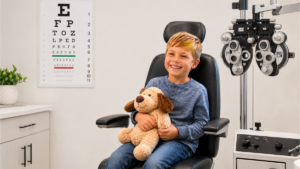
Infants should have their first
comprehensive eye exam at 6-12 months of age, then at age 3 & 5 and after every year.

Keep Enjoying Colorado Views

Many vision threatening eye diseases such as glaucoma, macular degeneration, cataracts, or diabetic retinopathy have no or minimal symptoms until the disease has progressed. Early detection is key to slowing progress, managing disease, and saving vision.

In addition to examining eye health, an optometrist is also is able to detect other health issues through a comprehensive eye exam like autoimmune conditions, allergies, medication complications, high blood pressure, high cholesterol, diabetes and more.

Protecting Your Eyes In Sports

Fall is here and sports season is officially in full swing.

Cleats are laced, uniforms fit and countless hours have been logged practicing in the backyard or driveway. But before the first whistle blows, it’s worth asking: Did we check everything?

We spend plenty of time making sure young athletes are physically ready. We schedule sports physicals, buy the right gear and map out strength training. But their eyes deserve that exact same attention.

Why Vision is the Ultimate Gear

An athlete’s eyes are hard at work the second the game starts. They are tracking a fast-moving ball, judging distances, scanning the court or field and reacting in milliseconds. According to the American Optometric Association¹, clear distance vision, depth perception, peripheral awareness and eye-hand coordination are just as important as any physical skill². This is precisely why kids need to learn to speak up for their vision.

If something changes, they need to know it’s not normal. Maybe the ball looks a little blurrier than last season. Maybe it’s harder to track under the lights or judge how far away a teammate is. Because vision changes happen slowly, kids often assume it’s just the way things are. Teaching them to notice when something feels off – and to tell a parent or coach – is a huge part of teaching them how to take care of their bodies.

Protecting the Vision They Rely On

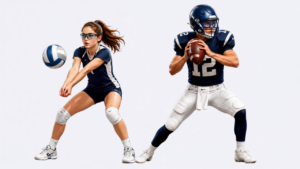
For athletes who already wear glasses or contacts, the job isn’t done. Everyday glasses aren’t built to handle the impact of a game, and contact lenses offer zero physical protection. The American Academy of Pediatrics³ recommends sport-appropriate protective eyewear, tailored specifically to the demands of the game. Your optometrist’s office can help fit your athlete for the perfect protective eyewear.

We ask a lot of young athletes. We train them, strengthen them and teach them to listen to their bodies when something hurts. Let’s make sure their eyes get the same level of care.

This season, let’s keep vision in the playbook. If you haven’t already, book an annual comprehensive eye exam with an optometrist near you, and find the protective eyewear that will make a slam dunk.

For more information on the visual skills athletes rely on and how to keep their eyes safe, check out the American Optometric Association’s Sports & Performance Vision Resource Page.

References 

  1. https://www.aoa.org/practice/specialties/sports-and-performance-vision
  2. https://www.aoa.org/healthy-eyes/vision-and-vision-correction/visual-acuity?
  3. https://www.healthychildren.org/English/tips-tools/ask-the-pediatrician/Pages/does-my-child-need-eye-protection-for-sports.aspx

Eye fact

Across the average human lifespan, a person will see over 24 million unique images.
Scroll to Top